Sustainability

Assessment
At Chemveda, we recently conducted our first materiality assessment to lay the foundation of our Environmental, Social and Governance (ESG) strategy. It allows us to gather insights on the importance of specific ESG issues, and to ensure that we prioritize the material issues that have the most impact on the economy, society, and environment. By engaging with various stakeholders, we not only get diverse perspectives of what areas have the biggest impact on value creation, and most influence the decision-making of our stakeholders, but this approach also makes our ESG efforts more impactful and relevant to our employees, clients, investors, and suppliers.
To identify the issues that matter most to our business and our stakeholders, we conducted a formal stakeholder-driven materiality process. The approach comprised a mix of primary and secondary research to identify and subsequently prioritize sustainability topics that are relevant for the company to focus on to preserve and enhance value over a long-term horizon.

- We identified a universe of 58 relevant ESG topics and emerging themes based on discussions with stakeholders, business requirements, global issues, peer review and benchmarking, sector scans and material topics identified by various frameworks and standards.
- Multiple frameworks, standards and stakeholder perspectives were considered to help prioritize topics and to further distil the themes that are material for Chemveda. After analysing survey responses from ~100 internal and external stakeholders, determining weights for stakeholder groups, thematic categorization of sub-topics, we shortlisted 18 topics in 10 themes, and synthesized the results into a materiality matrix for Chemveda.
- The materiality matrix allowed us to identify and categorize topics that are critical, significant, or important, and confirmed strong alignment between internal and external stakeholders in the prioritization of the majority of Environment and Governance topics.
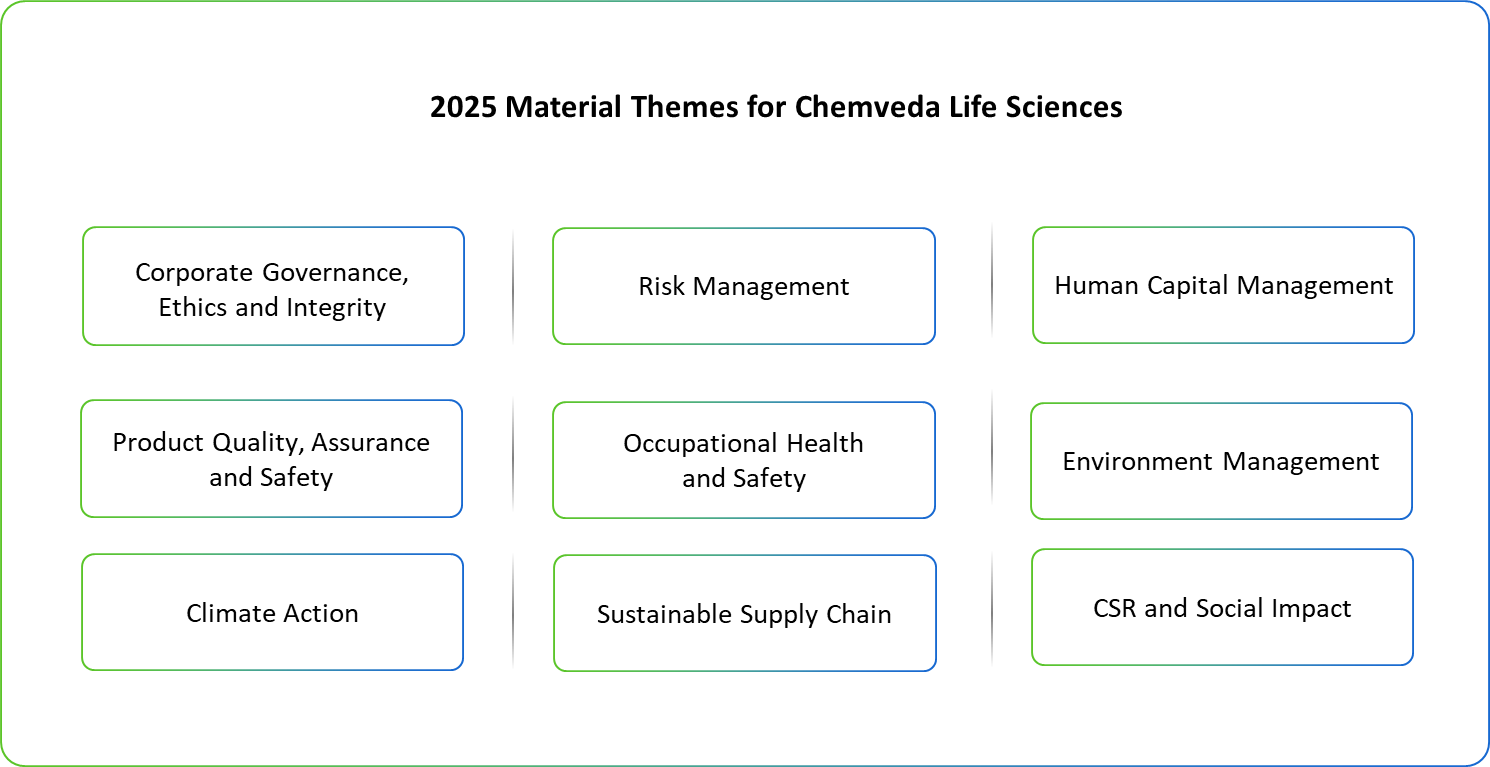
The results of Chemveda’s Materiality Assessments (MA) help identify our most “material issues” and determine the extent of management focus and depth of reporting.
Guides strategy: Identifying priority ESG issues helps us align sustainability with overall strategy, build business resilience and capitalize on new opportunities.
ESG disclosures and reporting: MA guides the content of non-financial disclosures and is essential to comply with the requirements of the GRI, SASB, Integrated Reporting, S&P Global, SEBI’s BRSR, etc.
Prioritizing resource allocation: Understanding the priority of ESG topics facilitates efficient allocation of people, resources, budget and investments – which are all finite.
Garner stakeholder trust: The involvement of key internal and external stakeholders builds trust, transparency and credibility. Factoring in the ‘stakeholder’s voice’ is critical to ensure mutual understanding and social license to operate.
The detailed results of the MA will be published in Chemveda’s upcoming ESG Report, but the following pages highlight the key focus areas and list the relevant policies governing our efforts.
Breakthroughs